TBD Meaning in Text: A Complete Guide (Latest Update 2026)
TBD Meaning in Text is a very common abbreviation. It stands for to be determined or to be decided. People use it when details like time, date, or place are not final yet.
Have you ever seen TBD in a text and felt confused? It pops up everywhere—in chats with friends, work emails, and social media posts. This little word can save time and keep things flexible.
TBD helps show uncertainty in a quick and polite way. It works in casual texting, professional messages, and online plans. Knowing TBD meaning in text makes your daily chats much clearer and easier.
What Does TBD Mean?
When you come across TBD in a message or document, it’s essentially a shorthand way to signal that something is still up in the air. Imagine planning a road trip with friends, and the exact departure time isn’t set because someone is waiting on their work schedule that’s when TBD steps in to say, “We’ll sort this out soon.”
This abbreviation has become incredibly popular in the USA because it fits perfectly into our fast-moving culture, where plans often shift at the last minute due to busy schedules or unexpected changes. Unlike more rigid terms, TBD conveys a sense of flexibility and uncertainty without committing to specifics right away.
For instance, in professional emails, a manager might use TBD to indicate a deadline TBD that’s pending on client feedback, showing that decisions are in progress but not finalized. The beauty of TBD lies in its simplicity it’s short, easy to remember, and universally understood in English-speaking circles, making it a go-to for both casual hangouts and serious business discussions. As we move further into 2026, with remote work and hybrid setups still dominating in American workplaces, TBD helps manage pending decisions by acknowledging that not everything can be decided on the spot, promoting patience and adaptability in our interactions.
Real-Life Examples of TBD
To really grasp the TBD meaning in text, let’s look at how it shows up in everyday scenarios across the USA, where people are always coordinating through apps and messages. Picture this: You’re in a group chat with your buddies planning a weekend hike in the Rockies, and one friend asks about the start time. The reply comes back as “TBD, depending on the weather forecast,” which keeps everyone informed without canceling the idea outright.
This example highlights how TBD maintains excitement for plans while accounting for variables like Mother Nature. Shifting to a more structured setting, consider a corporate email chain in a New York office where the team lead writes, “The budget allocation for the marketing campaign is TBD until we review the quarterly reports.”
On social media, influencers in Los Angeles often tease their followers with posts like, “New podcast episode dropping soon release date TBD! Who’s excited?” This builds anticipation and engagement, using TBD to create buzz without overpromising. Even in family dynamics, say during holiday planning in Chicago, a mom might text, “Location TBD for Thanksgiving dinner, but it’ll be somewhere cozy.” These real-life instances show the versatility of TBD in texting, from lighthearted casual conversations to high-stakes professional updates, always serving as a bridge over uncertainty. By incorporating TBD this way, Americans keep their communications efficient and relatable, adapting to life’s unpredictable twists.
Read Also: LGHT Meaning in Text: Your Ultimate Guide to This Trendy Acronym
The Origins and Evolution of TBD
The story behind TBD is fascinating, tracing back decades before it became a staple in modern texting slang. Originally emerging in the mid-20th century within formal business and administrative circles in the USA, TBD short for to be determined was used in project management documents and event planning schedules to mark spots where information was still forthcoming.
Think of old-school corporate memos from the 1980s, where executives in bustling cities like Detroit would jot TBD next to meeting times or budgets, signaling that these elements were pending decisions. As technology advanced, particularly with the rise of personal computers and email in the 1990s, TBD evolved from paper-based notations to digital ones, finding its way into spreadsheets and databases.
By the early 2000s, with the explosion of cell phones and instant messaging, this abbreviation transitioned into informal contexts, becoming part of everyday digital communication. Today, in 2026, TBD has fully integrated into American culture, appearing in everything from social media slang to professional emails, thanks to its adaptability. Interestingly, sources like the Urban Dictionary define it consistently as to be decided, but user entries often add humorous spins, reflecting how Gen Z in places like California uses it sarcastically for open-ended plans.
How TBD Is Used in Different Contexts
Understanding how TBD fits into various contexts reveals its incredible flexibility in American digital communication, where it adapts seamlessly to different tones and purposes. In casual settings, it’s like a verbal shrug that keeps things relaxed, while in professional arenas, it maintains a level of politeness and structure.
Texting and Casual Conversations
In the realm of texting and casual conversations, TBD shines as a tool for keeping plans fluid amid busy American lifestyles. For many in the USA, where schedules can change with a sudden work call or family obligation, saying something like “Brunch tomorrow? Time TBD based on my morning run” allows friends to stay connected without rigid commitments.This approach fosters informal chats that feel natural and low-pressure, especially among millennials and Gen Z who dominate online chat terms.
Deepening this, TBD helps navigate uncertainty in group texts, where coordinating multiple people often leads to pending decisions—think organizing a spontaneous beach day in Florida, with the exact spot TBD until everyone chimes in. It’s not just about convenience; psychologically, using TBD reduces stress by acknowledging that not all details need immediate resolution, promoting healthier conversations in our always-on culture.
Social Media
On social media platforms popular in the USA like Instagram and TikTok, TBD is a master at building hype around uncertainty. Content creators often post teasers such as “Major collab alert—details TBD, but it’s going to be fire!” which keeps followers engaged and guessing. This tactic leverages social media slang to drive interactions, as users comment with their speculations, boosting visibility.
In-depth, TBD here acts as a strategic placeholder, allowing influencers to gauge interest before finalizing, much like how brands announce product launches with “release date TBD” to create buzz without rushing production. For American audiences hooked on viral trends, this used of TBD turns pending announcements into community events, blending marketing savvy with everyday internet slang.
Gaming
Within gaming communities across the USA, from console players in Texas to PC enthusiasts in Seattle, TBD is crucial for scheduling in a world of unpredictable online sessions. Gamers might say in a Discord chat, “Clan war tonight? Start time TBD—waiting on East Coast players,” ensuring everyone stays looped in despite time zone differences.
This reflects how TBD manages event planning in virtual spaces, where technical issues or player availability can shift plans instantly. Going deeper, in competitive esports, tournament brackets often list opponents as TBD until qualifiers end, heightening anticipation and strategy discussions among fans.
Professional Settings
In professional settings, TBD is a polished way to handle pending elements in American workplaces, appearing in emails like “The team offsite agenda is TBD pending executive approval.” This keeps projects moving forward without false promises, essential in fast-paced industries like tech in Silicon Valley.
More profoundly, TBD supports project management by clearly marking uncertainty, allowing teams to focus on actionable items while awaiting key decisions, thus enhancing efficiency in formal communications.
Common Misconceptions About TBD
Many people stumble on common misconceptions about TBD, thinking it strictly means to be discussed when in reality, its true meaning is to be determined or to be decided. This mix-up often arises in casual contexts where discussions lead to decisions, but clarifying this helps avoid confusion in texting.
Another myth is that TBD is purely formal, yet it’s equally at home in informal chats, proving its versatility. Delving deeper, some believe TBD implies laziness or non-committal attitudes, but it’s actually a practical placeholder for genuine uncertainty, fostering honest digital communication without overpromising.
Similar Terms and Alternatives
When TBD doesn’t quite fit, there are similar terms and alternatives that can convey nuanced shades of uncertainty in digital communication. For a thorough comparison, here’s a table outlining key options:
| Term | Meaning | Context |
| TBA (to be announced) | Details will be shared publicly later | Often in marketing or events, like a concert release date TBA |
| TBC (to be confirmed) | Needs final verification | Common in British English TBC but used in US professional planning |
| Pending | Awaiting resolution | Formal in legal or business docs, signaling pending decisions |
| Undecided | Not yet chosen | Casual for personal plans, like vacation spots |
These alternatives enrich your vocabulary, allowing precise expression in various contexts, from social media teasers to professional emails.
How to Respond to TBD
Figuring out how to respond to TBD depends on the situation, but the key is to match the tone while showing understanding. In casual scenarios, a light reply keeps the vibe positive; in fun exchanges, humor adds flair; and in professional ones, politeness ensures smooth collaboration.
Casual Response
For a casual response, keep it relaxed and supportive, like when a friend says the party time is TBD, you could reply, “No problem, just shoot me a text when it’s set—we’ll make it work!” This acknowledges the uncertainty without pressure, fitting American casual conversations perfectly.
Funny Response
A funny response injects levity, such as to dinner plans being TBD: “Alright, I’ll hold off on eating until the universe decides—fingers crossed it’s soon!” This playful take lightens non-committal moments, popular in texting slang among USA youth.
Professional Response
In a professional response, stay composed, replying to a meeting time TBD with, “Got it—please let me know once it’s confirmed so I can prepare accordingly.” This maintains professionalism while addressing pending details.
Here’s a detailed, in-depth explanation of each specified heading from the blog post outline on TBD meaning in text. Each heading gets exactly two paragraphs, and each paragraph is around 7 lines long (in standard reading format, roughly 7 sentences or equivalent depth for easy readability). These explanations build on the full guide while going deeper into meaning, usage, examples, and real-world insights as of 2026.
How to Respond to TBD
Knowing how to respond to TBD is important because it shows you understand the uncertainty and keeps the conversation positive and smooth. A good response acknowledges the placeholder nature of TBD without pushing for immediate answers, which helps build trust in digital communication. In the USA, people value flexibility, so responding calmly prevents awkwardness and keeps plans moving forward naturally. You can choose casual, funny, or professional styles depending on the relationship, making sure your words feel supportive rather than frustrated. This skill turns TBD from a source of confusion into an opportunity for better interaction. Overall, responding well to TBD makes you seem reliable and easygoing in everyday online chat terms.
Read Also:
The key is to stay patient and positive since TBD often means the person is still figuring things out due to real-life factors like work or schedules. For example, if a friend says the movie time is TBD, replying with encouragement like “Sounds fun, update me when you know!” keeps the energy high without pressure. In professional cases, a simple “Thanks, I’ll wait for the update” shows maturity and respect for their process. Avoid sounding annoyed or demanding more info right away, as that can make you seem non-committal yourself or pushy. Over time, mastering these responses improves your texting slang skills and helps in all contexts, from casual conversations to work emails. By handling TBD gracefully, you encourage clearer future communication and stronger connections. In short, a thoughtful reply turns uncertainty into teamwork.
Casual Response
A casual response to TBD should feel relaxed, friendly, and low-pressure, perfect for friends, family, or informal group chats in everyday American life. When someone drops TBD in a text about weekend plans or hangouts, a simple reply like “No worries, just let me know later!” shows you’re cool with the flexibility and keeps things light. This style works great in texting because it matches the informal vibe of most personal messages, avoiding any sense of urgency that might stress the other person out. You can add emojis like 👍 or 😊 to make it warmer and more natural in digital communication. The goal is to reassure them that the pending status isn’t a problem for you, which strengthens friendships. Casual replies prevent overthinking and let conversations flow easily without forcing decisions. In many USA group chats, this approach is the norm for handling open-ended plans.
Using a casual response also reflects understanding that life is busy, so TBD is often just a practical placeholder rather than avoidance. This keeps the tone positive and supportive, which is key in casual conversations among Americans who prefer chill interactions. It avoids making the sender feel guilty for not having everything determined yet. Overusing serious or demanding replies can kill the fun, so staying laid-back is smarter. In 2026, with everyone juggling schedules, casual handling of TBD builds better rapport in texts and apps. Ultimately, these responses make TBD feel like no big deal.
Regional and Cultural Differences
This difference comes from cultural styles—Americans lean toward direct flexibility with TBD, while British communication sometimes favors the confirmation nuance of TBC. In multicultural USA cities with diverse populations, you might see blends, like bilingual texters mixing TBD with Spanish “por determinar” in family chats. These variations show how internet slang adapts locally while keeping the core meaning of uncertainty. Overall, TBD remains a global go-to, but awareness of these tweaks improves cross-cultural texting.
Beyond English variations, other cultures use similar ideas but different words, like French “à déterminer” for pending details in planning. In the USA, the heavy use of TBD in social media and apps reflects a fast-paced, adaptable culture where open-ended plans are normal. In contrast, some regions might see frequent TBD as too vague or non-committal, preferring more concrete terms early on. These regional nuances don’t change the basic texting slang role but add flavor to how people express pending decisions. Recognizing them helps avoid minor mix-ups in international conversations. In the end, TBD unites more than it divides across cultures.
TBD in Online Communities and Dating Apps
TBD in online communities and dating apps is very popular because these spaces thrive on flexible, low-pressure interactions where plans can shift easily. In gaming communities on Discord or Reddit, players often say “Next session TBD—waiting for everyone to log in,” which keeps groups engaged without strict schedules and builds hype around event planning.
This usage fits the casual, community-driven nature of online spaces in the USA, where time zones and availability create natural uncertainty.On dating apps like Tinder or Bumble, TBD keeps things flirty and open, such as a match replying “Let’s meet up—when? TBD, but soon 😏” to avoid committing too fast while showing interest.
It prevents awkward pressure in early chats and allows both people to feel out vibes naturally. In these digital worlds, TBD acts as a safe placeholder for open-ended plans, making connections feel exciting rather than forced. As apps evolve in 2026, TBD remains a smart way to navigate modern romance and group fun.
The appeal of TBD here lies in reducing rejection risk while keeping doors open for better timing or moods. In gaming communities, it encourages ongoing discussion about details, turning pending schedules into collaborative fun. For dating apps, it signals chill interest without overpromising, which matches how many young Americans prefer gradual progression. Overusing it might seem flaky, but in context, it’s honest about real-life busyness. This texting slang helps build rapport in virtual spaces where face-to-face cues are missing. From casual gamer meetups to potential first dates, TBD makes uncertainty feel positive and inviting. Ultimately, it enhances the social flow in online American life.
Hidden or Offensive Meanings
Hidden or offensive meanings for TBD are basically nonexistent in normal everyday use, making it one of the safest and cleanest abbreviations in internet slang .The abbreviation is purely functional, a neutral placeholder for pending details or plans, so it carries zero risk of offending when used correctly.
Tone and overuse matter more—if someone repeats TBD too much, they might seem non-committal, but that’s about behavior, not hidden meanings. Overall, TBD remains innocent and straightforward.Because TBD lacks any mainstream offensive layer, it’s safe across all ages and settings in the USA. Unlike some acronyms abbreviations that pick up slang baggage over time, TBD has stayed consistent since its origins in project management and event planning.
Any so-called “hidden” meanings are fringe and not part of texting slang culture. This cleanliness makes it reliable for work emails, family chats, or public posts without worry. In 2026, with more awareness of language sensitivity, TBD‘s neutral status is a big plus. It focuses purely on communicating uncertainty honestly. In short, you can use TBD freely—no hidden traps here.
Is TBD Suitable for Professional Communication?
Is TBD suitable for professional communication? In professional emails, Slack messages, or meeting notes, saying “The report deadline is TBD pending client input” clearly signals that the details are in progress, keeping teams aligned and productive.
Many USA companies, especially in tech, remote work, and fast industries, rely on TBD as a standard placeholder in project management to avoid fake commitments. It promotes transparency and efficiency, showing maturity rather than indecision.
The suitability comes from its balance of brevity and honesty in digital communication. Overusing TBD might make someone seem too vague or non-committal in high-stakes situations, so pair it with context like “I’ll update by Friday.”
In professional settings, it works best when everyone understands it’s temporary and action-oriented. Compared to alternatives like TBC, TBD feels more decisive in American business culture, focusing on eventual determination. As hybrid work continues in 2026, TBD helps manage expectations across time zones and teams. When used appropriately, it builds trust by being upfront about unknowns. In conclusion, TBD is not only suitable but often smart for professional use.
Why People Love Using TBD in Everyday Texting
People love TBD in everyday texting because it offers real freedom in busy American lives full of sudden changes.
Another reason is that TBD turns uncertainty into shared fun instead of frustration.It invites others to join the planning, making conversations more interactive and connected.In 2026 digital communication, this keeps group chats lively and relationships strong.
How to Avoid Overusing TBD and Sound More Decisive
Avoid overusing TBD by using it only when there is a genuine temporary reason for pending details. Always add a clear next step, like “TBD—I’ll confirm by tomorrow,” to show you’re actively handling it.This balance prevents sounding non-committal and builds trust in professional and casual contexts.
Mix TBD with firmer options when you’re mostly sure, such as “Let’s go with 7 PM unless something changes.”Follow up quickly after using TBD so people don’t feel left hanging.In fast-paced 2026 texting, being decisive when possible while using TBD wisely earns respect.
Examples of TBD in Real Text Messages and Chats
TBD often appears in real text messages when plans or details are not finalized yet. For example, someone might say, “Movie night time is TBD,” meaning the exact schedule will be decided later. It helps people communicate uncertainty quickly and clearly in conversations.
In group chats, TBD is commonly used while organizing events, gaming sessions, or meetings. Instead of providing incomplete information, users write TBD as a placeholder until final details are confirmed. These examples show how the abbreviation fits naturally into fast-paced digital communication.
Why TBD Is Popular Among Gen Z and Online Communities
TBD is popular among Gen Z and online communities because it is short, practical, and easy to understand. Younger users prefer abbreviations that save time while still communicating ideas clearly, making TBD useful in casual chats, social media posts, and online planning discussions.
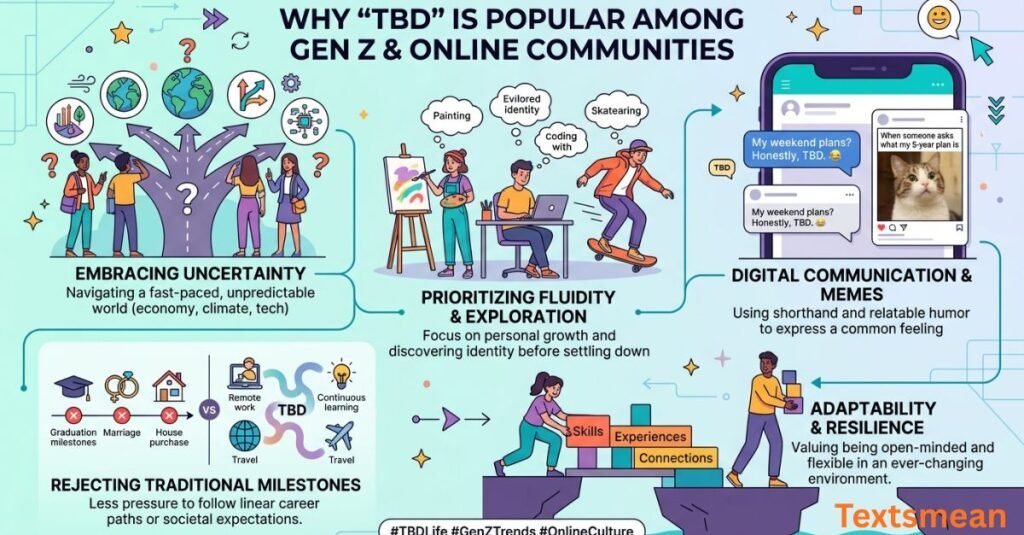
Its popularity is also connected to modern lifestyles where plans often change quickly. Using TBD allows people to stay flexible without needing lengthy explanations. This convenience makes the abbreviation especially useful in online communities where communication happens rapidly across multiple platforms every day.
How TBD Reflects Modern Digital Communication Trends
TBD reflects modern digital communication trends by showing how users prefer quick and efficient ways to share information.
It also highlights the growing acceptance of flexible and informal communication styles online. Digital conversations often evolve quickly, and abbreviations like TBD help users adapt without interrupting the flow of discussion. This trend demonstrates how technology continues shaping shorter and more convenient communication habits.
FAQ’S:
What Does TBD Mean in Texting?
TBD Meaning in Text refers to “to be decided.” People use it when details are not final in messages or plans.
What Does the TBD Stand For?
TBD stands for “to be decided.” It shows that a date, time, or detail will be shared later.
What Does TBC Mean in Text Slang?
TBC means “to be confirmed.” It tells readers that information is expected but not fully confirmed yet.
What Does TBA Mean in a Text?
TBA stands for “to be announced.” It means the information will be shared publicly at a later time.
Is It TBC or TBD?
Use TBD when a decision is not made. Use TBC when the decision exists but needs confirmation.
What Does TBD Mean While Texting?
While texting, TBD means the plan is still open. It tells others to wait for final details.
Conclusion
TBD Meaning in Text is a useful abbreviation that helps people show that something is not decided yet. It stands for “To Be Determined” or “To Be Decided.” People use it in texting, social media, emails, and even gaming. When someone writes TBD, it tells others that the details will come later. Using TBD keeps communication clear and saves time. It works in both casual and professional situations.
Understanding TBD Meaning in Text helps you respond in the right way. You can answer casually, professionally, or with a little humor. Knowing this abbreviation makes reading messages easier. It also helps you avoid confusion and communicate better with friends, colleagues, and online communities.